Address
Room 910,1B Yuefu Plaza, No.481 Guangming Avenue,Guangming District, Shenzhen, China.

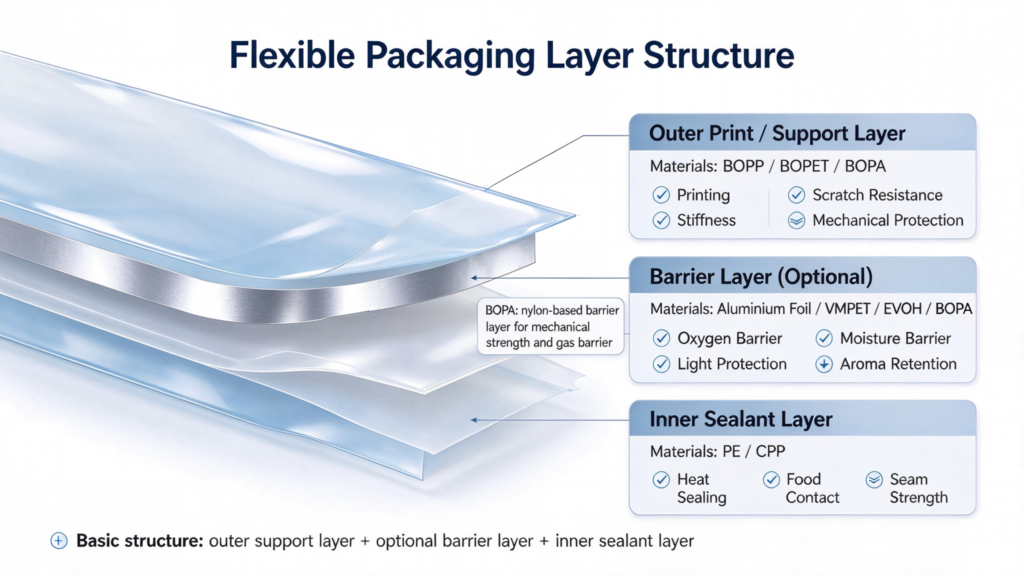
In flexible packaging, each film layer has a different function. The outer layer supports printing, the barrier layer protects the product, and the inner layer provides heat sealing.
However, defects in the films may cause problems during printing, lamination, pouch making or retort processing. Understanding these defects can help packaging manufacturers identify possible causes more quickly.
1. Outer Layer: PET Film
PET film is widely used as the outer layer because of its good printability, strength and dimensional stability.
Common defects include:
- Surface scratches: May affect package appearance and, in severe cases, interfere with lamination.
- Low surface energy: Insufficient or reduced surface treatment may lead to poor ink adhesion or weak bonding.
- Surface contamination: Oil, dust or other contaminants may cause uneven printing or poor lamination.
- High thermal shrinkage: Unsuitable PET grades may shrink or wrinkle during high-temperature processing.
Possible complaints: Poor print quality, ink peeling, local bubbles, wrinkles or delamination after heat treatment.
2. Barrier Layer: Aluminum Foil and VMPET Film
Aluminum foil (AL) and metallized PET (VMPET) are used to improve barrier performance and protect products from oxygen, moisture and light.
Common defects include:
- Pinholes: Small holes in aluminum foil may reduce barrier performance.
- Cracks or damage: Excessive bending or handling damage may affect the barrier layer.
- Poor metal adhesion: The metal coating on VMPET may transfer or peel under certain conditions.
- Surface contamination: Oil or other contaminants may interfere with adhesive bonding.
Possible complaints: Reduced barrier performance, product oxidation, moisture damage, metal transfer, bubbles or delamination.
3. Reinforcement Layer: BOPA (NY) Film
BOPA, also known as nylon film, is often used to improve toughness and puncture resistance.
However, nylon absorbs moisture, which can affect its mechanical properties and dimensional stability. Moisture changes may also influence lamination and the performance of the complete structure.
Possible complaints: Wrinkles, changes in peel strength or delamination, particularly when the film structure is not well matched to the processing conditions.
4. Heat-Sealing Layer: PE and CPP/RCPP Film
PE and CPP are commonly used as inner sealing layers. RCPP is a specially designed CPP grade used in suitable retort packaging.
Common defects include:
- Additive migration: Certain additives may migrate to the film surface or interface and affect bonding over time.
- Poor heat-sealing performance: An unsuitable sealing temperature range may cause weak seals or damaged film.
- Low hot tack: Insufficient seal strength before cooling may cause freshly sealed pouches to open.
Possible complaints: Seal leakage, open seals, reduced peel strength or delayed delamination.
The correct film grade must match the actual filling, sealing and sterilization conditions. Ordinary PE or CPP should not be assumed suitable for high-temperature retort processing.
5. How to Troubleshoot Film-Related Complaints
Use the following points as a starting guide:
| Problem | What to Check First |
|---|---|
| Poor ink adhesion | Surface treatment, contamination and ink compatibility |
| Bubbles or weak lamination | Film surface condition, adhesive system and lamination process |
| Poor barrier performance | Pinholes, cracks and damage to the barrier layer |
| Wrinkles after retort | Film grade, moisture, thermal shrinkage and structure compatibility |
| Delamination after storage | Additive migration, bonding conditions and adhesive curing |
| Seal leakage | Heat-sealing temperature, pressure, dwell time and film grade |
These are possible causes, not final diagnoses. The same complaint may result from the film, adhesive, printing, lamination or pouch-making process.
Conclusion
Film quality plays an important role in flexible packaging performance. Choosing suitable PET, BOPA, BOPP, CPP and PE films, and matching them to the required packaging conditions, can help reduce production problems and customer complaints.
At GYJ New Material, we supply flexible packaging films for different applications. Selecting the right film starts with understanding the product, packaging structure and processing requirements.
Note: This article provides general troubleshooting guidance. Actual causes should be confirmed through testing and review of the complete packaging process.