Address
Room 910,1B Yuefu Plaza, No.481 Guangming Avenue,Guangming District, Shenzhen, China.

Flexible Packaging Structures Explained: PET/PE, PET/AL/PE and More
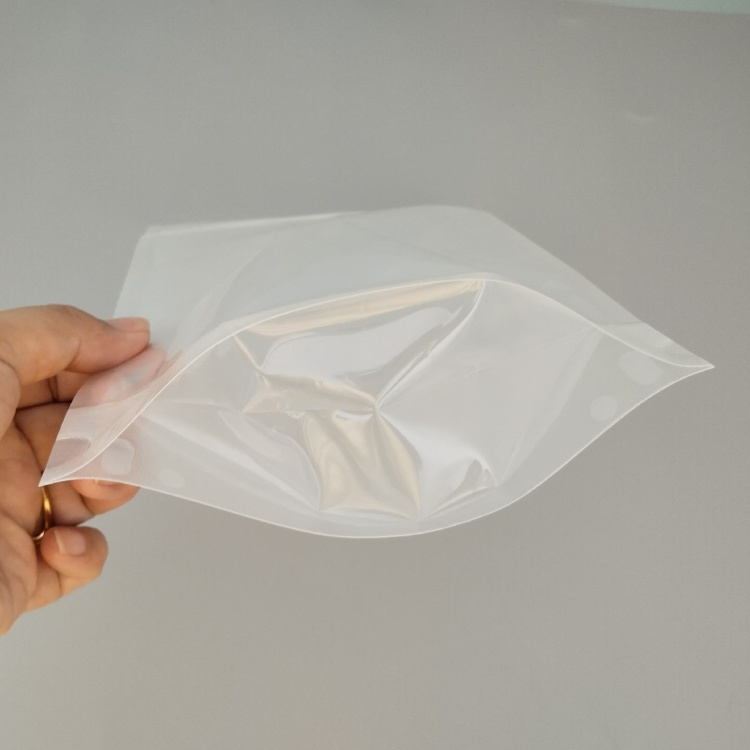
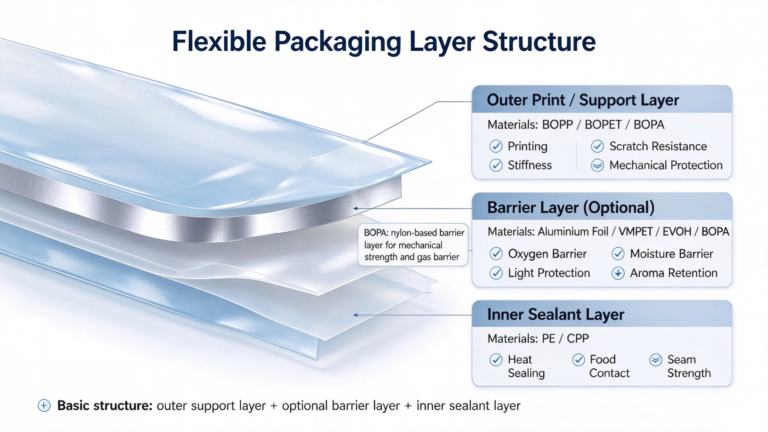
Flexible packaging uses different film combinations for different products. Common structures include PET/PE, PET/AL/PE, PET/NY/AL/PE and PET/AL/NY/PE.
Why are there so many combinations? Can one film replace another?
The answer is simple: each layer has a different job. The best structure depends on the product, required protection and packaging conditions. More layers do not always mean better packaging.
1. What Does Each Film Do?
Different materials provide different properties:
PET: Good printability, stiffness and dimensional stability.
BOPP: Good stiffness, gloss and printability, often used for cost-effective packaging.
BOPA (NY): Good toughness, puncture resistance and flexibility under repeated bending.
AL (aluminum foil): Excellent barrier against light, oxygen and moisture.
PE: Good heat sealing and flexibility.
CPP: Good heat sealing and commonly used as an inner layer.
RCPP: Retort-grade CPP designed for suitable high-temperature sterilization applications.
The adhesive between layers is also important. It must provide sufficient bonding strength and withstand the intended conditions, such as boiling, retort processing or contact with oil.
2. Common Flexible Packaging Structures
PET/PE: A Basic Two-Layer Structure
PET provides a good printing surface and stiffness, while PE provides heat sealing.
This structure is suitable for many dry foods and everyday products when high barrier performance is not required.
However, it may not provide enough protection for products that need a long shelf life or strong protection against oxygen, moisture and light.
PET/AL/PE: High-Barrier Packaging
This structure combines PET for printing, aluminum foil for barrier protection and PE for heat sealing.
It is commonly used for coffee, tea, milk powder and other products requiring strong barrier performance.
However, aluminum foil can develop pinholes if it is exposed to severe bending, folding or pressure. When the package contains sharp or hard products, additional mechanical protection may be needed.
PET/NY/AL/PE vs. PET/AL/NY/PE
These structures contain the same materials, but the position of NY is different.
PET/NY/AL/PE
NY is placed outside the aluminum foil. It can help protect the foil from external impact, bending and handling stress.
PET/AL/NY/PE
NY is placed between the aluminum foil and PE. It can help protect the foil from pressure or sharp points coming from the product side.
The right structure depends on the main risk. Product shape, vacuum level, package size and transportation conditions should all be considered.
PET/PET/AL/PE: Why Use Two PET Layers?
Adding another PET layer can improve stiffness, thickness, handling and protection of the printed surface.
However, a second PET layer does not replace the barrier function of aluminum foil. It also increases material cost.
This structure may be useful when the package needs a firmer feel or better mechanical performance.
3. When Is BOPP or PET a Better Choice?
BOPP and PET are both widely used as outer films, but they are not interchangeable in every application.
BOPP is often suitable for cost-effective packaging that needs good gloss, stiffness and printability.
PET is often preferred when higher dimensional stability, strength or heat resistance is needed.
For high-temperature applications, the complete structure must be designed for the actual processing conditions. The outer film alone cannot determine whether a package is suitable for boiling or retort sterilization.
4. Boilable Pouches vs. Retort Pouches
These two applications have different requirements.
Boilable packaging is generally designed for processing at or below 100°C, while retort packaging may require temperatures around 121°C or higher.
For retort applications, RCPP is commonly used as the inner sealing layer. PET and NY may provide printing and mechanical protection, while aluminum foil can provide high barrier performance.
The adhesive must also be suitable for the required temperature and product contents.
The final structure should be confirmed through testing under the actual sterilization conditions. Simply replacing PE with RCPP does not automatically make a pouch suitable for retort processing.
5. How to Choose the Right Structure
Before selecting a film structure, consider these questions:
Does the product need a long shelf life? Consider aluminum foil or other suitable barrier materials.
Does the package need puncture resistance? BOPA may help improve toughness and resistance to damage.
Will the package be boiled or retort sterilized? Select suitable films, sealant and adhesive systems.
Does the product contain sharp pieces, oil or acidic ingredients? Evaluate mechanical protection and material compatibility.
Does the package need extra stiffness? PET or additional layers may help, but the extra cost should be justified.
There is no single structure suitable for every product. The right choice depends on the product, packaging equipment, storage conditions and required performance.
6. Choosing the Right Packaging Film
At GYJ New Material, we supply flexible packaging films including BOPA, BOPP, CPP, PET and PE for different packaging applications.
Understanding the properties of each film is an important step toward choosing the right material combination. We work with customers to identify suitable film options based on their application and requirements.
The key is not to use more layers, but to use the right materials for the right purpose.
Note: The structures discussed in this article are general examples. Final material selection should be confirmed through testing and evaluation under actual production and packaging conditions.